Wednesday, March 30, 2011

Why I Love Rhapsody

Amazon Cloud Player? No thanks.

So Amazon is getting a lot of attention with the introduction of its new cloud-based music service. Yawn…
I don’t see that it stacks up at all against Rhapsody, a truly cloud-based music service.
About two years ago I was at QCon San Francisco and had a great, wide ranging conversation with a software engineer from Rhapsody.  About a year later, while calculating how much I was spending on music every month – mostly on iTunes, occasionally on Amazon – I remembered that conversation and visited the Rhapsody site. The price was right, $10 a month for all the music I wanted.
I signed up, and haven’t looked back.
Short-sighted luddites will say, “Yeah, but you can’t download the music, and if you drop your subscription, your music goes away.” Wrong.
Here’s the deal….
The only reason we buy CDs or download music is a matter of access. You lay down your money to insure that you can listen to your tunes any time you want, any where you want. That concept made sense in the steam-powered days before the Internet. Back then you either carried your music with you on some kind of storage device (cassette tape, portable CD player, or later, MP3 player) or you listened to it on the radio. Your access to music was limited by how much you could afford to buy, and/or what your favorite radio station played.
Fast-forward a couple of decades… Cassettes are dinosaur bones, and CDs are going extinct as you watch. Most music is purchased online and downloaded to a computer, where it can then be transferred to a portable MP3 player. A vast improvement in convenience over vinyl or CDs, but not without issues.
One big issue is storage. Once you download that music you have to put it somewhere safe so that if your computer craps out the money you’ve invested in tunes doesn’t vanish along with all your other data.
So you buy back-up drives, or you pay for a back-up service like Carbonite. That made sense. Once.
Which brings me to why I love Rhapsody:
  • At $10 bucks a month I now pay a fraction of what I used to pay for music on iTunes.
  • Storage is no longer an issue. True, I still have 10,000 songs on my hard drive (one of the reasons I have a Carbonite account). But most of the music I “own” and regularly listen to is available on Rhapsody. So if I lost those files through hard drive failure, not a big deal. In fact, had Rhapsody been around when I bought those tunes originally, I could have saved a ton of money.
  • I can listen to entire albums by unfamiliar artists at absolutely no risk. If I like what I hear,  I add it to my Rhapsody library. No messing around with 30 second samples. If I don’t like what I hear, no loss. This means that I end up listening to a lot of stuff I might otherwise miss because I didn’t want to risk $10 on an unfamiliar album in iTunes. So I can afford to expand my musical horizons, because no matter how many songs or entire albums I add to my Rhapsody library, I still pay only $10 a month. I spend more on coffee.
  • The Rhapsody app on my iPhone makes my Rhapsody library portable. I can put my phone in the dock  connected to the sound system in my living room, or plug my phone into the system in my vehicle.
  • Music in my Rhapsody library can be downloaded to my iPhone for listening when I’m not connected to the 3g network or wifi.
Is there a downside? Yes. Rhapsody’s music selection is vast, but limited. There are some gaping holes, in fact. No Beatles, for one. But iTunes only added the Fab Four in the past year, so that omission isn’t all that surprising.  But Rhapsody’s selection also includes a lot of music that I was surprised to find, rare stuff by some obscure bands. And I expect that as time goes on the gaps will be filled.
In the end, it’s all about access. As long as I have 24/7/365 access to the music I want, why would I want to store the stuff locally? Like many people I’m getting pretty damn tired of the term “cloud computing,” but that’s where it’s all headed. Most of my TV viewing is now done via Netflix and Hulu Plus – services that offer the same benefits as Rhapsody: a vast selection of on-demand content that I can access through multiple devices anytime I want, anywhere I want.
And if Rhapsody goes away, some other service will be there to take it’s place. My music will always be available. No files, no storage, no risk. Just all the tunes I want.
So Amazon’s Cloud Music Player…? No biggie.


Saturday, December 25, 2010

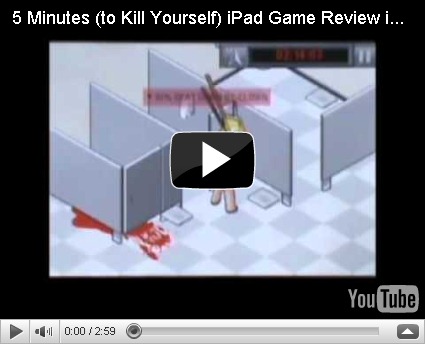
Game Review: 5 Minutes to Kill (Yourself)

One of a series of game review videos I did that appeared in two different publications: TapTilt, an experimental magazine for the iPhone, and Sideways, an equally experimental magazine for the iPad. Both were produced by SIdeways LLC, which is doing still doing innovative stuff in e-publishing. 

del.icio.us Tags: ,,,

iPad Game Review: Predators

This is the last of a series of game review videos I did for Sideways, an experimental magazine published exclusively on the iPad. While the magazine only put out three issues, the company behind the magazine, Sideways LLC, is still very much alive, and doing some truly amazing stuff in the e-publishing realm.

Wednesday, October 06, 2010

Spicy With a Side of Deadly

Tabasco with SwordAmong my friends hot peppers are not so much a culinary matter as they are a gauge of manhood. While some guys go in for bungie jumping or skating down the sides of tall buildings, my buddies test their testosterone by eating things that other people use to repel muggers.

Let’s face it, hot peppers as a flavor enhancer are fine. But at the point where the cook is using life-threatening peppers, it’s gone beyond food. We’re into the realm of self-mutilation here. Why eat something that tastes good, but hurts really bad? If you’re going to do that you might as well just eat a good meal and then ask the waiter to drive staples into your forehead.

One friend is a pepper fanatic, known for his delicious home-made beef jerky (he marinates it for hours in napalm). He’ll often offer samples to his friends. These taste tests are a kind of sadomasochistic, male-bonding, pain-endurance ritual. “Try some of this,” he says. Then all the guys stand around chewing, making appreciative noises, watching each other to see who’s going to cry.

“Delicious,” I manage to say, while several of my major organs hand in their resignations.

I once saw a chart that described the wide variety of hot peppers and their relative heat. It turns out that the serial killer of hot peppers is the mighty habanero. NASA used habaneros to test the re-entry tiles on the Space Shuttles. Habanero farmers are required to register with Homeland Security. Special permits are necessary to ship habaneros through populated areas.

So naturally, somebody thought that cooking with habaneros would be fun. Probably someone who enjoys shaving with a belt sander.

I once had dinner with some friends in a Manhattan restaurant that specialized in spicy Southwestern cuisine. The menu featured a variety of dishes like “Eat This and Die Pork,” and “Flaming Ulcer Beef.” Right away, a challenge, a gauntlet thrown, a little, mocking voice saying, “What’s the matter, Mr. Pansy Basket?”

After a few Mexican beers my machismo-meter was in the red zone. I was no longer the middle-aged blonde guy from the midwest. I was Paunchy Villa! I ordered a dish called “Death by Chilies.”

Death does not frighten me, amigo.

The meal was a delicious chicken concoction, very potent, but within my range of tolerance. I became overconfident. Off to one side of my plate were two habanero peppers. I popped one into my mouth.

Really hot peppers don’t hit you right away, especially if you’re washing down your meal with beer. It took about a five-count before I stopped breathing. I was pretty sure that the pepper had eaten through my tongue and jaw, and was laying in my lap. I drank water, beer, wine, moist towelettes, anything cold and wet. I was perilously close to writhing. Writhing in a restaurant is frowned upon, even in New York. I sat very still, trying not to weep openly.

“Death By Chilies?” They should have named this stuff “Beg For A Bullet In The Head Chicken.”

After weeks of counseling by sensitive professionals I was able to talk about the experience. I’m a better man for it.

Months later I was sitting in a Cleveland bar when a couple sat next to me and ordered chicken wings. The bartender asked, “You want Mild, Spicy, or Deadly?”

The couple thought it over. The man was tentative. He said, “Could we have Spicy, with a side of Deadly?”

I finished my drink and left a buck on the bar. Amateurs, I thought. Wimps.

[This item was originally published in a slightly different form in 1996 in Howdy, what was then the AOL humor section.]

Friday, May 21, 2010

Books in the Cloud?

Reading E-Books Rewrite Bookselling in today’s Wall Street Journal got me thinking about how much the manner in which I consume media has changed of late.

Several months ago I cancelled all of my cable movie channels and re-activated my NetFlix account; I stream the movies more often watching via DVD.  Similarly, I also recently started using Rhapsody (love it!), a fantastic alternative to downloading and storing music -- and worrying about secure back-ups to protect my investment. I also cancelled my Sirius-XM account because my iPhone is a far more useful and flexible alternative (especially with the Rhapsody app.)

So a great deal of the media I consume lives in the Cloud, where I can access it via a variety of devices.  Is there a similar model on the horizon for the publishing industry?

While I often read newspaper and magazine articles on my iPhone, the idea of reading a book on that device never appealed to me. But the iPad offers an excellent book-reading experience, so much so that I doubt that I'll purchase another paper book (with the exception of library sales and the occasional irresistible remainder bargain.)

But rather than having to download and store digital copies of books, I'd love to see a model similar to Rhapsody or NetFlix, where I pay for 24/7, any-device access to the e-books I want to read.

Audible, the digital audiobook company, has a  sort of hybrid model. The audiobooks I've purchased are permanently stored on the site, where they can be streamed to my computer. The downside is that if I want to listen on my iPhone I have to download the file and then upload to my device. But unlike content I purchase from iTunes, if any of my Audible purchases are accidentally deleted, I can download another copy from the site. (An Audible iPhone app that allows me to stream titles in my library seems like a no-brainer, no?)

(At least as far as music is concerned, Apple's purchase of Lala may signal a move to a cloud-based model that will go head-to-head with Rhapsody. Time will tell.)
Audible also offers monthly membership deals that allow users to download a predetermined number of titles each month.

So as the new breed of ebook stores comes online, I hope someone offers a model similar to NetFlix, Rhapsody, and Audible.


Cross posted to Bob Rhubart’s Blog and Smallification